

Contents
Does getting a dental crown hurt?
In short: usually not. Having a dental crown fitted is painless in most cases.
What happens at each step?
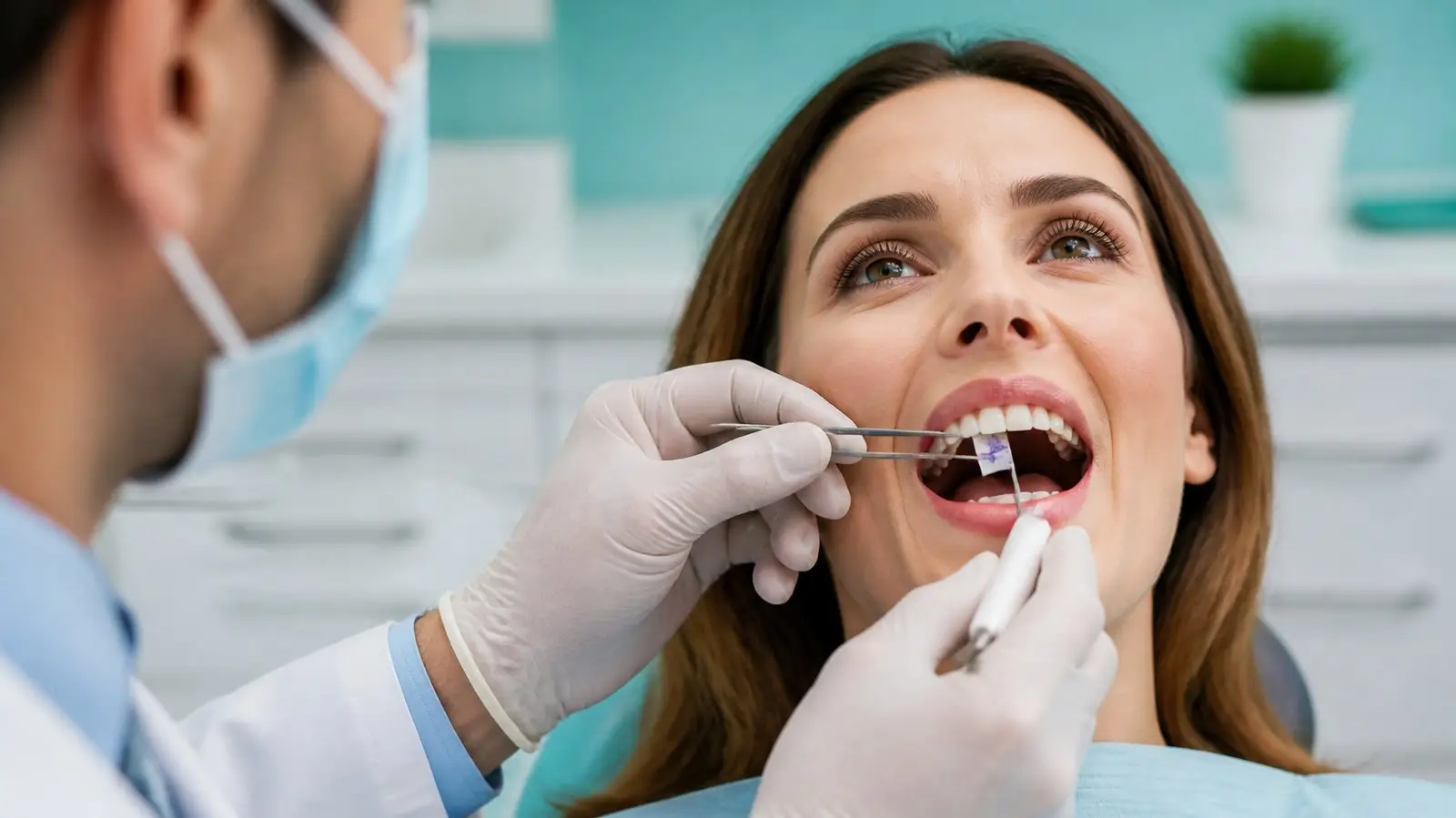
- Preparation: the tooth is usually reshaped, and a temporary build-up or post may be placed. This is done under local anaesthetic, so apart from pressure you should not feel anything while the tooth is being prepared.
- Impression or scan: both conventional impressions and digital scans are painless.
- Try-in and cementation: fitting the finished crown is normally painless too. You may feel brief pressure or slight discomfort while it is seated and cemented.
- After the anaesthetic wears off: pain or sensitivity may appear, especially when biting hard or with cold and heat. This is usually temporary and can be eased with painkillers (e.g. ibuprofen or paracetamol) and by avoiding hard foods.
- If it hurts badly or for a long time: possible causes include a high bite, inflammation at the root tip, a leaking crown or irritated gums. In that case, see your dentist promptly.
Is pain normal after a crown is fitted?
In short: yes. Mild to moderate pain or sensitivity after a crown is fitted is common and usually settles within a few days to a few weeks. Severe or persistent pain, however, is a warning sign and should be checked by a dentist.
Why pain can occur
- Irritation of the tooth structure during preparation.
- A reaction of the dental nerve (pulpitis) to heat, pressure or work close to the nerve.
- A feeling of pressure during cementation or because of a high contact point (the bite is not quite right).
- Inflammation at the root tip, or a nerve that was already damaged before treatment.
- Irritation of the surrounding gum during treatment.
Typical symptoms that are usually harmless
- Sensitivity to cold or heat.
- Pain when biting hard or chewing.
- A dull ache or slight throbbing for a few days.
- Mild gum irritation or tender gums.
When to see your dentist soon
- Severe, throbbing pain.
- Pain when you bite down that stops abruptly when you release (a sign of a high bite).
- Pain that gets clearly worse rather than better after 48–72 hours.
- Persistent, increasing swelling or fever.
- Numbness or unusual changes in sensation.
What you can do yourself
- Take painkillers as directed on the pack (e.g. ibuprofen or paracetamol), provided you have no contraindications.
- Eat soft foods and avoid hard, sticky or very hot or cold food.
- If you suspect the crown is too high, book an appointment promptly to have it adjusted.
- For swelling, use a cold compress on the outside of the cheek (not directly on the gum).
Possible follow-up treatments
- Bite adjustment: a simple, quick fix when the crown is “too high”.
- Root canal treatment: if the nerve is irreversibly damaged.
- Removing and remaking the crown: if the seal or fit is causing problems.
What causes pain under a crown?
Below are the most common causes of pain under or around a crown – with how to recognise them and what to do.
1. High bite (occlusal interference)
- What it is: the crown sits slightly too high, so the tooth meets its opponent before the neighbouring teeth do.
- Symptoms: pain on biting, often noticeable straight away; a feeling of pressure; pain increases when you bite and eases when you release.
- Solution: the dentist adjusts the crown by polishing down the high spots – quick and straightforward.
2. Irritation or inflammation of the dental nerve (pulpitis)
- What it is: preparation, heat or deep reduction can irritate the nerve. At first this is reversible; later it can become irreversible.
- Symptoms: sensitivity to cold and heat, persistent throbbing pain, spontaneous pain, pain at night.
- Solution: monitoring for mild symptoms; root canal treatment may be needed if symptoms persist or worsen.
3. Root tip inflammation (apical periodontitis)
- What it is: a bacterial infection in the root canal, often the result of an irreversibly damaged pulp or incomplete root canal treatment.
- Symptoms: severe, throbbing pain; tenderness when biting; swelling, possibly a fistula or swollen lymph nodes; a dark area at the root tip on X-ray.
- Solution: root canal treatment or retreatment; in rare cases extraction.
4. Secondary decay under the crown
- What it is: leaking crown margins or poor adhesion allow bacteria to get under the crown.
- Symptoms: often no visible signs at first; later pain when chewing, sensitivity, a fistula or dark margins; decay is often visible on X-ray.
- Solution: removing the crown, treating the decay and, if necessary, a new build-up and a new crown.
5. Loose or defective crown margin, poor seal
- What it is: the cement washes out and tiny gaps form.
- Symptoms: sensitivity to cold, occasional pain, food trapping, an unpleasant taste; risk of decay and pulpitis.
- Solution: re-cementing or remaking the crown.
6. Fractures (of the root or the remaining tooth)
- What it is: cracks can form under the build-up, or a tooth that was already weakened breaks.
- Symptoms: sudden, sharp pain when chewing; mobile fragments; possibly swelling.
- Solution: depending on the extent, extraction or – rarely – a post build-up and a new crown.
7. Problems with a post or post-and-core build-up
- What it is: a loose or broken post, a perforation or damage during canal preparation.
- Symptoms: pain when chewing, noticeable looseness, sensitivity; possibly visible on X-ray.
- Solution: removing and replacing the post or another type of restoration; sometimes extraction.
8. Gum-related causes (gingivitis, periodontitis)
- What it is: inflammation of the tooth-supporting tissues, either unrelated to the crown or caused by its margin.
- Symptoms: bleeding gums, pocket formation, tenderness, possibly tooth mobility.
- Solution: periodontal treatment, cleaning under the crown margin, surgical measures if necessary.
9. Allergic or irritant reaction to materials
- What it is: rare; a sensitivity reaction to metal alloys or cement.
- Symptoms: local inflammation, redness, a burning sensation; usually no severe toothache.
- Solution: switching material, in consultation with your dentist or prosthodontist.
10. Bite-related muscle or jaw joint problems
- What it is: a faulty bite overloads the chewing muscles or the jaw joint (TMJ), which can be felt as toothache.
- Symptoms: muscle ache, headache, jaw joint pain, pain when opening the mouth wide.
- Solution: bite correction, splint therapy, physiotherapy.
How long does sensitivity last after getting a crown?
In short: usually a few days to a few weeks. In some teeth, however, sensitivity can last several months or be a sign of more serious damage.
Immediately after treatment (hours to 1–3 days)
- Cause: the local anaesthetic wears off; tissues and nerve are irritated by the preparation.
- Symptoms: pressure, slight throbbing, general sensitivity.
- Course: usually eases considerably within 24–72 hours.
Short-term sensitivity (3 days to 2–6 weeks)
- Cause: reversible pulpitis (temporary irritation of the nerve) or a mild inflammatory reaction.
- Symptoms: pain with cold or heat, tenderness when chewing, occasional spontaneous pain.
- Course: improves steadily; most symptoms should have clearly subsided after 2–6 weeks.
Longer-lasting (6 weeks to 3 months)
- Cause: slowly settling irritation, a marginal leak, an emerging root canal problem.
- What to do: if symptoms are still noticeable after 6–8 weeks, have the tooth checked. An X-ray is usually taken and the nerve’s vitality and signs of inflammation are assessed.
Chronic or increasing pain (more than 3 months, or getting worse)
- Cause: irreversible pulpitis, apical periodontitis (root tip inflammation), a fracture, a leaking crown with secondary decay.
- What to do: prompt examination; often root canal treatment, possibly a new crown or extraction.
Practical guide – when to see the dentist
- Pain does not clearly ease within 1–2 weeks → book an appointment.
- Pain gets worse rather than better, especially at night or spontaneously → get checked immediately.
- Pain on biting that disappears when you release → possible bite adjustment (crown too high) or fracture – book a short-notice appointment.
- Swelling, a fistula or fever → seek dental treatment immediately.
When should I see a dentist about pain under a crown?
The following signs clearly point to a problem that needs treatment.
Immediately (emergency)
- Severe, throbbing pain that does not respond to painkillers.
- Visible swelling of the face or mouth, fever, or difficulty swallowing or breathing.
- Pus or a visible fistula (a small “pimple” on the gum).
- Sudden, marked loosening of the crown or tooth.
At short notice (within 24–72 hours)
- Severe pain on biting or persistent tenderness, especially if the pain stops quickly when you release (a sign of a high bite or a fracture).
- Pain that does not improve, or gets worse, over 48–72 hours.
- Strong, persistent sensitivity to heat or cold that does not gradually decrease.
- New discolouration (darkening) of the tooth together with pain.
Soon, if symptoms persist (within a few days to weeks)
- Mild to moderate sensitivity that is not clearly improving (e.g. still noticeable after 7–14 days).
- Recurring but not very severe pain with certain triggers (biting, cold food).
- An unpleasant taste or smell around the crown (a sign of a leak or infection).
- Gum recession or persistent bleeding at the crown margin.
What should I do if my crown is too high?
In short: a high bite can usually be corrected quickly and almost painlessly at the dentist. Until your appointment, resting the tooth, short-term painkillers and soft food will help.
What you can do right away
- Rest the tooth: avoid chewing hard on the affected side; eat soft food.
- Pain relief: if needed, ibuprofen or paracetamol as directed on the pack, provided you have no contraindications.
- Cold: cold compresses on the outside of the cheek (20 minutes, then a break) can ease pain and swelling. Do not apply directly to the mucous membrane.
- Avoid hot food and drinks: temperature changes can intensify the pain.
What the dentist will do
- Bite check: using articulating paper, the dentist sees where the crown makes contact too early.
- Adjustment (quick, minimally invasive): the high contact points are polished down in the chair. This is usually painless – anaesthetic is rarely needed, as only the crown is being reshaped.
- Follow-up: the bite is checked again after adjustment and fine-tuned if necessary.
- If pain persists: if the pain was not caused by the bite alone, further tests follow (percussion test, vitality test, X-ray). Possible further treatments include root canal treatment, removing and remaking the crown, or treating a fracture or gum disease.
Can a crown lead to root canal treatment?
In short: yes. In some cases a crown can make root canal treatment necessary – either shortly after preparation or later as a result of complications.
1. Direct irritation of the nerve during preparation
- Reshaping the tooth removes tooth structure, sometimes close to the nerve. Heat, pressure or over-preparation can trigger reversible or irreversible pulpitis.
- Reversible irritation often heals within days to weeks. With persistent, spontaneous or throbbing pain, root canal treatment may be needed.
2. Pre-existing, undetected nerve damage
A tooth that was deeply decayed or symptomatic before the crown was planned may have a damaged or non-vital pulp even if it looked symptom-free. The crown can then trigger symptoms or reveal the problem – and root canal treatment becomes necessary.
3. Secondary decay or a leaking crown
If bacteria get under the crown (for example because the cement has washed out or the margin does not fit well), decay and pulp inflammation can develop, requiring root canal treatment.
4. Trauma during build-up or post problems
Injury while placing a post, a perforation or excessive leverage during build-up can damage the nerve.
5. Fracture of the tooth or root
Cracks can develop under the crown; with a root fracture the tooth often cannot be saved, and extraction may follow.
6. Overloading and bite problems
Chronic overloading (e.g. from a high bite) can damage the pulp or cause it to die.
How common is this?
Not very common. With a first crown placed to a high professional standard, the risk of later needing root canal treatment is low but real. Studies report varying rates (typically in the single-digit percentage range), depending on the findings, the amount of tooth structure lost and previous treatment.
Warning signs that root canal treatment may be needed
- Persistent, increasing, spontaneous or night-time pain.
- Strong sensitivity to heat (or first to cold, then to heat).
- Tenderness when chewing, swelling, a fistula.
- Darkening of the tooth (a sign of a dead pulp).
- A dark area at the root tip on X-ray (after examination).
Frequently asked questions about dental crowns
| Question | Answer |
|---|---|
| Can an allergy to the crown material cause pain? | Rarely, but it is possible: intolerance to alloy components or resin can cause local irritation or pain. |
| Does the risk of pain depend on the crown material (metal, ceramic, zirconia)? | Material mainly affects allergy and aesthetic aspects. The risk of pain depends more on the extent of preparation, the condition of the pulp and how accurately the crown fits. |
| What can I do in the short term about toothache under a crown? | Gentle painkillers (e.g. ibuprofen or paracetamol as directed on the pack), avoiding hard or very hot or cold food, and cold compresses if needed. Having it checked by a dentist is still important. |
| Can a crown come loose and cause pain? | Yes. A loose crown can cause irritation, decay underneath and therefore pain. If you notice it loosening, see your dentist promptly. |
| How does the dentist find the cause of the pain? | Through a clinical examination, a bite check, a pulp vitality test and X-rays to assess decay, the seal at the margin and the root tip. |
| How can pain be avoided in the long term? | Good oral hygiene, regular check-ups, prompt treatment of decay and a well-planned, accurately fitting crown all reduce complications. |
| How much does follow-up treatment for a painful crown cost? | It varies widely with the cause: a simple adjustment costs little, while root canal treatment or a new crown costs considerably more. Check the guarantee terms with your dentist. |
| Does the crown have to be removed if the pain persists? | Sometimes: for an accurate diagnosis or treatment (e.g. root canal treatment), the crown has to be removed and later refitted or replaced. |
Related pages: Dental bridge pain · Dental crown prices in Sopron · Zirconia crown prices · Dental crowns in Sopron, Hungary · Root canal treatment prices
At our practice in Sopron, Hungary, you get transparent crown prices and a free initial consultation – with savings of up to 70% compared with typical Western European prices.
→ Dental crown prices in Sopron: coradent.at/en/dental-crown-prices/ · 📞 +36 99 340 424
This article provides general information and does not replace a personal dental examination. If you have symptoms, please consult your dentist.